
Service
Brickwork Repointing and Brick Repair Across London & Kent
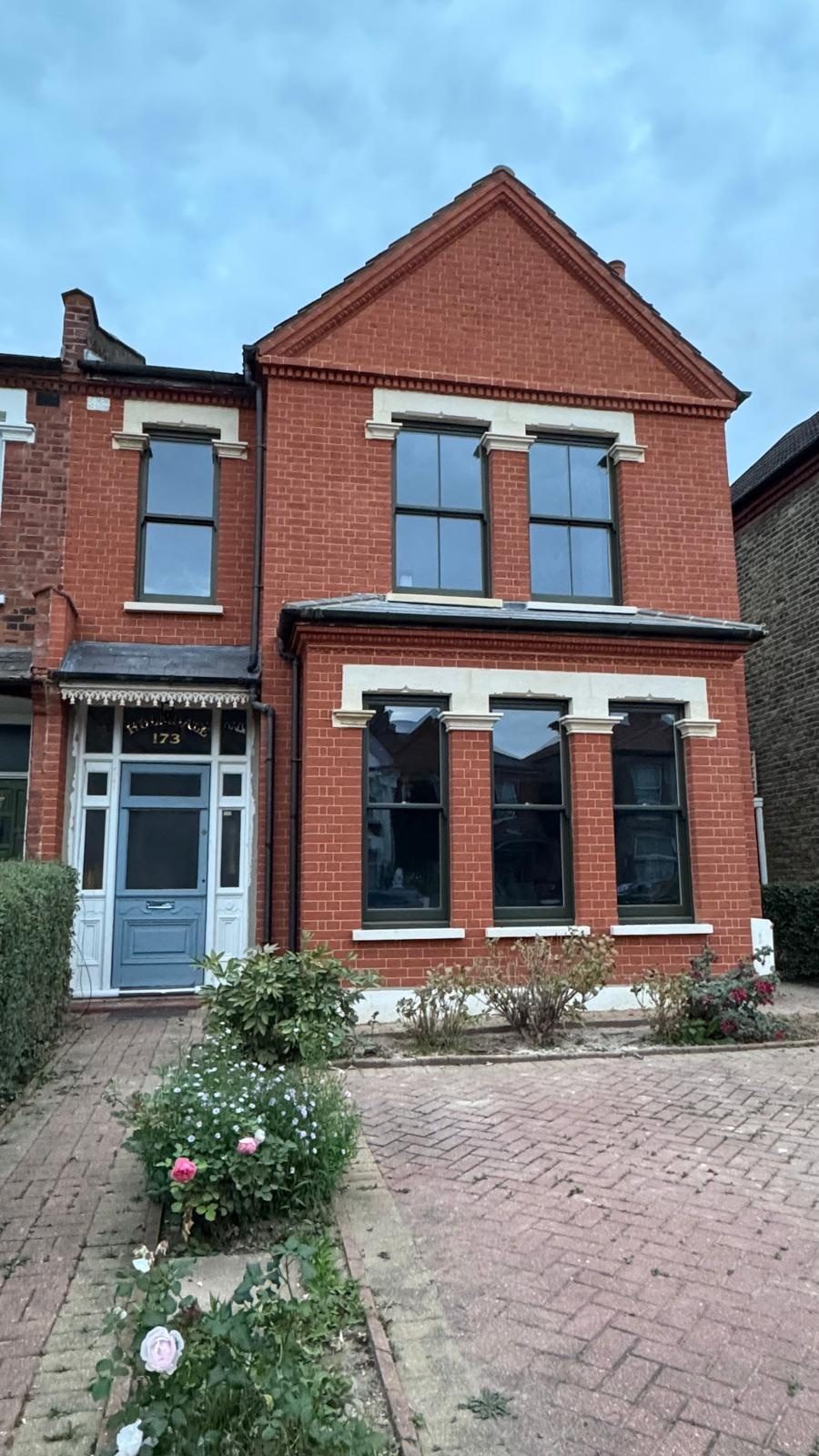
Tired joints raked back to sound material and repointed to one consistent line, with spalled and cracked bricks cut out and replaced, so the elevation sheds water and looks deliberate again.
18 years on brickwork · £2m public liability insurance
- 18 years' experience
- £2m public liability insurance
- 10-year workmanship guarantee
- K Rend approved installer
- Listed on TrustATrader
What brickwork repointing and repair covers
Repointing renews the mortar joints; brick repair deals with the bricks themselves. On most tired elevations you need both, joints that have receded and a scatter of bricks whose faces have blown off and are now holding water rather than shedding it.
The work is raking out failed mortar to a proper depth, cutting out and replacing damaged bricks with the closest match we can source, repointing in a mortar suited to the wall, and finishing the joint to a single consistent profile across the elevation.
On pre-1919 solid walls that means lime mortar; on modern brickwork built in cement, a cement mix is correct. Matching the mortar to the wall is the decision that determines whether the work protects the brick or destroys it.
Who needs it and when
Any brick property whose joints have gone soft, sandy or hollow. That includes Victorian and Edwardian terraces across south-east London, interwar semis through Bexley, Sidcup and Bexleyheath, and modern housing where a south-westerly elevation has taken years of driving rain.
The usual triggers: mortar you can scrape out with a key, sand collecting on the sills and path, joints that have receded behind the brick face, spalled or flaking brick faces, stepped cracking, a previous repoint that is now falling out in strips, or a survey flagging open joints before a sale.
It is also commonly done while scaffolding is already up for roofing, chimney or gutter work, the access cost is the expensive part and it is already paid for.
What happens if it is left
The cost of leaving it another winter
An open joint is a funnel. Water collects in the recess, soaks into the mortar bed and the brick around it and sits there. On a solid wall there is no cavity to intercept it, so it arrives at the inside face as a damp patch; on a cavity wall it saturates the outer leaf and can bridge across debris or a misplaced tie.
Frost then does the damage. Wet brick faces spall, and once a face has gone the brick absorbs more water than before, so the rate of loss accelerates. Replacing a handful of bricks is routine. Replacing hundreds across an elevation is a different job with a different price, and matched replacements never weather identically to the originals.
At high level and on free-standing walls it becomes structural. Deep open joints reduce the bedded area carrying the load, which is how parapets, garden walls and chimney stacks end up leaning, bulging and needing rebuilding rather than repointing.
Common mistakes we are called in to undo
- Using an angle grinder to rake joints on soft stock brick, widening the joints and permanently damaging brick edges.
- Repointing an old lime-built wall in hard sand and cement, which forces water out through the brick face and causes spalling.
- Skimming new mortar over old rather than raking back to twice the joint width, so the new pointing debonds within a couple of years.
- Patch-pointing one small area with a different sand, leaving an obvious mismatched square on the elevation.
Our process
How a brickwork repointing & repair job runs from first call to guarantee
Step 1
Inspection
We check mortar hardness and depth, brick type and condition, the existing joint profile, exposure, and anything above feeding water onto the wall: gutters, copings, sills and flaunching.
Step 2
Diagnosis and specification
We set the mortar mix, sand match and joint profile, and identify which bricks need cutting out. You get a written fixed price with a payment schedule spread across the project.
Step 3
Access and raking out
Access is arranged by us. Joints are raked back to sound material at a depth of at least twice their width, dust removed and the wall dampened so it does not pull water out of the fresh mortar.
Step 4
Brick replacement and repointing
Failed bricks are cut out and rebedded in matching mortar, then joints are filled in layers, compacted and finished to the agreed profile consistently across the elevation.
Step 5
Clean down, verification and guarantee
The face is brushed back, fresh work protected while it cures, and the elevation checked with you before access comes down. Completed work carries our 10-year workmanship guarantee.
What you get
The results this work is actually bought for
The wall sheds water again
A properly filled, compacted and profiled joint throws water off the face instead of collecting it in a recess.
You stop losing brick faces
Repointing in the right mortar takes the wear itself, which halts the spalling cycle before it becomes a brick replacement bill.
An elevation that reads as one
Matched sand and one consistent profile across the wall is the difference between a repointed house and a patched one.
Real value at sale or survey
Open joints get flagged on surveys and used to negotiate. Sound, recently repointed brickwork does the opposite.
Decades between cycles
Done properly to full depth, repointing is a long-cycle job, so the annual cost of keeping the wall sound is small.
Fewer damp problems inside
Most penetrating damp on brick elevations starts at the joints. Closing that route is the cheapest damp fix available.
In detail
Brickwork repointing & repair: materials, methods and where it applies
Mortar: matching the wall, not the shelf
The governing principle is that the mortar should be weaker than the brick. Soft handmade and Victorian stock bricks need lime. Modern, harder facing bricks built in cement can take a cement-lime-sand mix. Getting this backwards is the single most damaging thing done to old brickwork in this country.
Sand choice sets the colour and texture. We match against the surviving original mortar in a sheltered part of the wall, because that is what the new work will eventually weather towards, not against a fresh sample under scaffolding lighting.
Joint profiles and what they do
Weatherstruck sheds water off the joint and suits exposed elevations. Bucket handle gives a well-compacted, durable joint and is the workhorse on general stock brickwork. Flush and fine ribbon suit gauged and fine-jointed façades. Recessed profiles look sharp on modern brick but hold water and are a poor choice on soft, exposed old work.
Whatever the profile, the joint has to be compacted. An under-pressed joint is porous no matter how neat it looks on day one.
Read moreShow less
Brick replacement, cracking and related repairs
Spalled bricks are cut out individually and replaced with reclaimed or matched bricks, bedded in the same mortar as the surrounding repointing. Where a face has only just started to flake, it is sometimes better to turn or leave the brick and repoint tightly around it than to disturb sound surrounding masonry.
Stepped or vertical cracking is treated as a symptom, not a filling job. We look for the cause, settlement, a corroding steel lintel, thermal movement, a missing movement joint, and deal with that before rebuilding the masonry. Associated work often includes rebedding copings, rebuilding parapets and repointing chimney stacks while access is up.
Houses, garden walls and commercial brickwork
Domestic work is generally elevation-by-elevation, prioritising whichever face takes the weather. Free-standing garden and boundary walls are more exposed than house walls, they weather on both faces and from the top, so copings and cappings are always part of the assessment.
Commercial and block work brings access planning, agreed hours and insurance requirements, all of which we handle. We cover London and Kent, including Bexley, Bexleyheath, Sidcup, Dartford, Erith, Bromley and Orpington.
Not sure this is the right specification for your wall? See all of our services, the areas we cover, or go back to the homepage.
FAQs
Brickwork repointing & repair questions we are asked most
How much does repointing cost?
It is priced per elevation on area, access, joint depth and how much brick replacement is involved. You get a written fixed price after we have seen the wall, with payments spread across the project. Quotes are free. Small jobs carry a minimum charge.
How long does repointing take?
A single elevation on a typical house is usually days rather than weeks once access is up. Whole properties take longer. The programme is in writing with your quote.
How do I know if my brickwork needs repointing?
Mortar that crumbles when scraped with a key, joints recessed behind the brick face, sand collecting on sills and paths, spalled brick faces, or damp appearing inside on the weather-facing wall.
Can you match my existing mortar and brick?
We match sand, mortar colour and joint profile to the existing work, and source the closest available brick match for replacements. Reclaimed bricks usually blend best on older property.
Should my wall be repointed in lime or cement?
Lime if the wall was built in lime or the brick is soft, cement is harder than the brick and causes the face to blow. Cement mixes are appropriate on modern brickwork built in cement.
How long does repointing last?
Done to full depth in the correct mortar and properly compacted, it is a long-cycle job measured in decades. Exposure and the condition of gutters and copings are the main variables.
Is the work guaranteed?
Yes: 10-year workmanship guarantee on completed work, £2 million public liability insurance, and we are listed on TrustATrader.
Can you repoint just one section of wall?
Yes, where the rest of the joints are genuinely sound. We will tell you honestly whether a patch will blend or whether the whole elevation is the better result.
Do you repoint garden and boundary walls?
Yes, including copings and cappings, which is where free-standing walls usually fail first.
Do you work on listed buildings?
No. Period and conservation-area property yes, listed buildings no.
Related work
Often carried out alongside this
Hydraulic lime repointing
Breathable lime mortar joints for period and solid-wall brickwork, matched to the original pointing style.
Read moreChimney repointing
Stacks repointed, flaunching renewed and weathering details reinstated, with our own access arranged.
Read moreExterior damp specialists
We trace penetrating damp back to the failed pointing, render or detail causing it, then put the fabric right.
Read moreFree quote
Brickwork back to a clean, consistent, weather-tight line
Send the property details and a close-up photo of the joints. We will tell you what has failed, what it needs and what it costs: in writing, free, with no obligation.
- 18 years' experience
- £2m public liability insurance
- 10-year workmanship guarantee
- K Rend approved installer
- Listed on TrustATrader