
Service
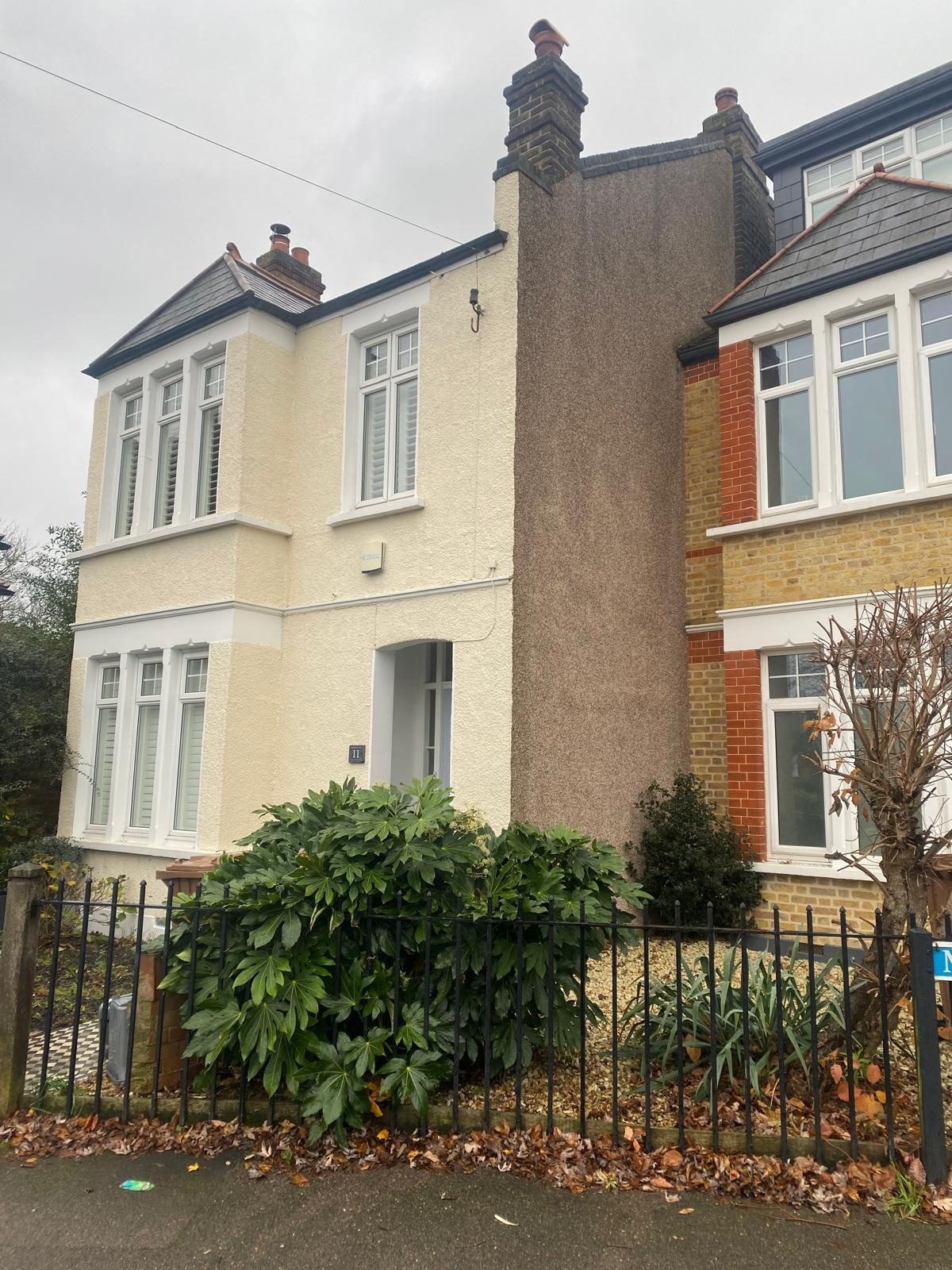
Sand and Cement Rendering Specialists in London & Kent
A hard-wearing traditional render laid in proper coats and gauged correctly, durable, cost-effective and straight, with the beads and details that stop it cracking away later.
18 years' rendering experience · 10-year workmanship guarantee
- 18 years' experience
- £2m public liability insurance
- 10-year workmanship guarantee
- K Rend approved installer
- Listed on TrustATrader
What sand and cement render is
Sand and cement render is the traditional wet render: a scratch coat applied to the substrate and keyed, followed by a float coat rubbed up to an even finish. It is thicker and heavier than thin-coat systems and has been the standard external finish on British masonry for generations.
Its strengths are durability and cost. It is tough, impact-resistant, straightforward to repair locally, and it is the most economical way to get a clean, uniform external wall on blockwork, brick and garden walls.
It is normally decorated with a masonry paint or a mineral coating, and it can be finished smooth, floated, or given a textured or Tyrolean finish depending on the look you want.
Who it is for and when it is needed
It suits blockwork extensions, garages, outbuildings, boundary and retaining walls, modern cavity-wall houses, and any elevation where a robust painted finish is the right answer for the budget. It is also the usual repair medium where a property is already rendered in sand and cement and you want a like-for-like repair.
It gets specified when existing render has blown or cracked across a whole elevation, when new blockwork needs covering, when mismatched extensions need to be brought into one uniform surface, and when a property is being prepared for sale and the external walls are letting it down.
On pre-1919 solid walls built in lime, a hard cement render is usually the wrong choice, it traps moisture. We will recommend a breathable lime specification instead where the wall calls for it.
What happens if it is left
The cost of leaving it another winter
Render that has blown is already letting water in. You can hear it: tap the wall and hollow areas sound completely different from sound ones. Water gets behind the render through a crack, the bond breaks over a wider area each winter, and the section eventually falls away, often taking paint and substrate face with it.
The pattern that costs the most is water tracking down behind a render skin. It does not show where it enters. It shows as a damp patch a metre lower, or inside the property against a wall nobody suspected, and by then the wall behind has been wet for months.
Cracking is the early warning. Fine map cracking is usually shrinkage and can be managed; straight vertical cracks at openings, or cracks that widen, are stress and movement, and rendering over them simply means they reappear in the same place within a year.
Common mistakes we are called in to undo
- Applying render in one thick coat instead of scratch and float coats, which cracks and debonds as it shrinks.
- Over-gauging the cement to make it 'stronger', producing a brittle render that cracks and pulls off the substrate.
- Taking render down to or below ground level with no bell or stop bead, so moisture wicks up behind the finish.
- Rendering straight over a live crack or a movement joint rather than cutting it out and carrying the joint through.
Our process
How a sand and cement render job runs from first call to guarantee
Step 1
Inspection
We tap-test the existing surface, map hollow and cracked areas, identify the substrate and check the details: ground clearance, sills, verges and any movement joints.
Step 2
Diagnosis and specification
We set the coat build-up, mix gauge and finish to suit the substrate and exposure, then issue a written fixed price with a payment schedule spread across the project.
Step 3
Access, strip-out and beading
Access is arranged by us. Blown render is removed back to sound material, the substrate is prepared and dampened as needed, and corner, stop and bell beads are fixed plumb and level.
Step 4
Scratch coat and float coat
The scratch coat is applied and keyed, allowed to cure properly, then the float coat is laid to the beads and rubbed up to the agreed finish, working wall by wall to keep the surface consistent.
Step 5
Curing, verification and guarantee
The render is protected while it cures, then checked for flatness, hollow spots and clean detailing before access comes down. Completed work carries our 10-year workmanship guarantee.
What you get
The results this work is actually bought for
Genuinely hard-wearing
It stands up to knocks, ladders and weather better than thin-coat finishes, which is why it is still the default on garages, boundary walls and high-traffic elevations.
The most cost-effective full-wall finish
For covering large areas of blockwork or tired brickwork to a uniform surface, nothing beats it on price per square metre.
Straight lines and true corners
Properly set beads and two-coat work give flat elevations and crisp arrises, which is what makes a rendered house look professionally finished.
Easy to repair and redecorate
Local damage can be cut out and patched in the same material, and the colour is entirely in your control at repaint.
Weather protection for the masonry
A sound render coat is a sacrificial weather shield that keeps driving rain off the wall behind it.
Any finish you want
Smooth, floated, textured or Tyrolean, and any paint colour, so a mismatched extension can be brought into line with the main house.
In detail
Sand and cement render: materials, methods and where it applies
Mixes, gauging and coats
A render works when each coat is slightly weaker than the one beneath it. Getting the gauge wrong in the other direction is the classic failure: a rich, hard top coat on a weaker base shrinks harder than what it is stuck to and pulls itself off. We gauge the mix to the substrate and the exposure, not to a single habit.
Coat thickness and curing time matter just as much. The scratch coat has to be keyed and given time to take up before the float coat goes on, and in warm or windy weather the work is dampened down so it cures rather than dries out too fast and crazes.
Finishes and variations
A smooth or sponge-float finish suits contemporary elevations and takes masonry paint cleanly. A floated finish gives a slightly open texture that hides minor variation well. Textured and Tyrolean finishes throw a heavier surface that is very durable and traditional on interwar housing across Kent and south-east London.
Sand and cement is also the workhorse for plinths, garden and retaining walls, garage elevations and outbuildings, where a thin-coat system would not take the abuse.
Read moreShow less
Substrates, keys and details
Dense blockwork, engineering brick and previously painted surfaces all need the right key: mechanical raking, a bonding coat, or lath where the surface cannot be relied on. Rendering onto a surface that will not hold it is the most avoidable failure in this trade.
Beads and terminations do the long-term work: bell beads at the base to throw water clear, stop beads at openings and verges, corner beads on arrises, and movement joints carried through where the structure has them. Skip them and the render fails at the edges first.
Domestic and commercial applications
On houses the job is usually a full elevation or whole property, phased so the household keeps access and the work is protected overnight. On commercial buildings and blocks the same build-up applies with more coordination around occupants and agreed working hours.
We cover London and Kent: Bexley, Bexleyheath, Sidcup, Dartford, Erith, Bromley and Orpington, and see the full range of substrates, from Victorian stock brick to 1970s blockwork.
Not sure this is the right specification for your wall? See all of our services, the areas we cover, or go back to the homepage.
FAQs
Sand and cement render questions we are asked most
How much does sand and cement rendering cost?
It is priced by area, access and how much existing render has to come off first. You get a written fixed price after we have seen the wall, with a payment schedule spread across the project. Quotes are free. Small jobs carry a minimum charge.
How long does rendering a house take?
The scratch coat has to cure before the float coat, so it is a multi-day job and weather affects it. We give you the programme in writing with the quote.
How long before I can paint new render?
New render needs to dry and carbonate before decoration: rushing paint onto green render traps moisture and causes patchy, flaking finishes. We will tell you the right window for your job and the conditions it is curing in.
Why does render crack?
Usually over-strong or over-thick mixes, drying too quickly, missing movement joints, or structural movement below. Each cause has a different fix, which is why we diagnose before quoting.
Can you patch-repair existing render?
Yes. Blown sections are cut back to sound material and rebuilt in matching coats. Where the whole elevation is tired, a full re-render usually gives a better result than a patchwork.
How long does sand and cement render last?
Properly mixed, keyed and detailed render on a sound wall is a long-life finish measured in decades. The decoration over it needs renewing on a much shorter cycle than the render itself.
Is the work guaranteed?
Yes: 10-year workmanship guarantee on completed work, and we hold £2 million public liability insurance. We are listed on TrustATrader.
Is cement render suitable for an older solid-wall house?
Usually not. Solid walls built in lime need to breathe, and a hard cement render traps moisture. We would specify a lime-based system for that wall instead.
Do you render garden and boundary walls?
Yes: walls, plinths, garages and outbuildings as well as house elevations, across London and Kent.
Related work
Often carried out alongside this
Render repair & crack remediation
Cracked, hollow or blown render cut out, rebonded and blended back so the repair does not read as a patch.
Read moreSilicone render
Through-coloured, self-cleaning silicone systems that shed water and hold their finish for years.
Read morePebbledash removal & re-rendering
Stripping failed pebbledash back to sound substrate and re-rendering in a modern, low-maintenance finish.
Read moreFree quote
A flat, straight, hard-wearing rendered elevation
Send us the property details and a photo of the wall. We will tell you whether it needs patching or re-rendering and put a written price in front of you, free and without obligation.
- 18 years' experience
- £2m public liability insurance
- 10-year workmanship guarantee
- K Rend approved installer
- Listed on TrustATrader