
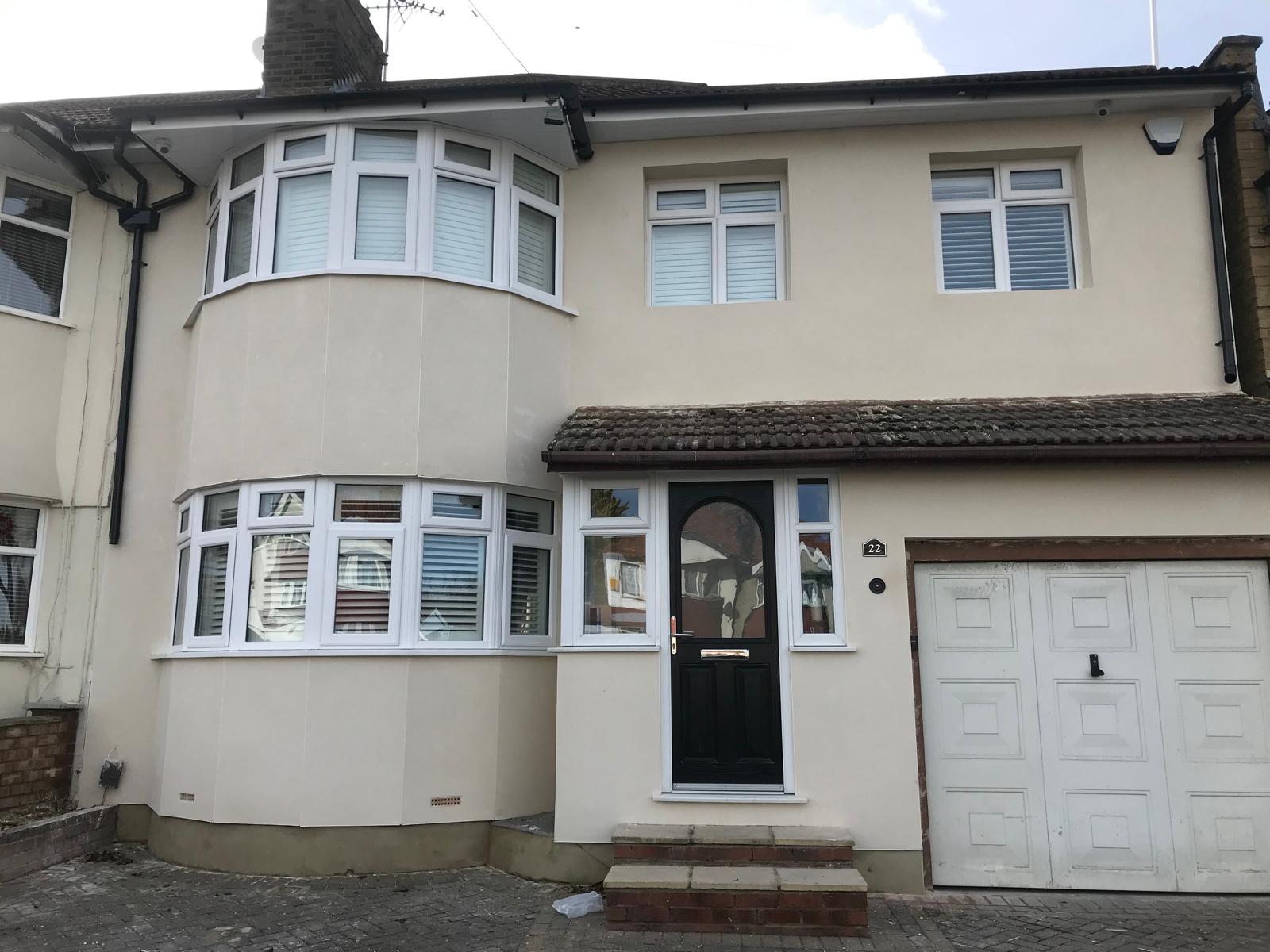
Service
Silicone Render That Stays Clean Across London & Kent
A through-coloured, water-repellent system applied over a properly prepared base coat, so the wall keeps its colour without repainting, and rain runs off instead of soaking in.
18 years on external walls · £2m public liability insurance
- 18 years' experience
- £2m public liability insurance
- 10-year workmanship guarantee
- K Rend approved installer
- Listed on TrustATrader
What silicone render is
Silicone render is a thin-coat decorative topcoat containing silicone resin, applied over a base coat that has been reinforced with an alkali-resistant mesh. The colour runs all the way through the material rather than sitting on top as paint, and the silicone content makes the surface hydrophobic: water beads and runs off, carrying surface dirt with it.
That combination is why it behaves differently from painted sand and cement. There is no paint film to flake, no annual repaint, and the surface is breathable enough to let water vapour out of the wall while keeping liquid rainwater off it.
The finish is usually a 1mm or 1.5mm scraped texture, available in a wide range of colours including the greys, off-whites and anthracites that most London and Kent homeowners ask for.
Who it suits and when to specify it
It suits modern cavity-wall houses, extensions, blockwork, existing sound render that needs a new life, and properties where the owner is tired of repainting a rendered elevation every few years. It is also the standard finish over external wall insulation.
The usual triggers are a tired painted render that is patchy and algae-stained, a pebbledash elevation that has just been stripped, a new extension that needs to be tied in visually with the main house, or a whole-house refresh where the owner wants a modern, uniform look.
It is not the automatic answer for every wall. On solid-wall period properties that need to breathe freely, a lime-based specification is usually the correct call, and we will say so rather than sell you the wrong system.
What happens if it is left
The cost of leaving it another winter
A failing painted render gets worse in a predictable order. The paint film loses adhesion, water gets behind it, the render below stays permanently damp, and green algae and black staining take hold on the north and west elevations. At that point repainting only buys a season, because you are painting over a wet substrate.
Once water is sitting in the render, freeze-thaw does the rest. The render debonds from the wall in patches, sounds hollow when tapped, then cracks and falls away, usually starting at the most exposed corner and the base of the wall.
The costly version of this is water reaching the inner leaf and the internal finishes: stained plaster, perished decoration and, in older extensions, damp timber. Recoating a sound wall is straightforward. Replacing failed render, drying out a wall and redecorating inside is a different budget entirely.
Common mistakes we are called in to undo
- Applying a thin-coat silicone topcoat straight onto hollow or cracked existing render, so the new finish fails with the old one underneath.
- Skipping the reinforcing mesh in the base coat, which is what controls cracking at stress points and around openings.
- Leaving beads, stop ends and drip details out, so water tracks back behind the render at the base and at openings.
- Painting over algae-stained render instead of treating the cause of the damp, which returns within a year.
Our process
How a silicone render job runs from first call to guarantee
Step 1
Inspection
We survey the elevation, tap-test any existing render for hollow areas, check the substrate, and look at the details that matter: verges, sills, thresholds, penetrations and ground clearance.
Step 2
Diagnosis and system selection
We confirm the substrate is suitable, choose the base coat, mesh, beads and topcoat grain and colour, and issue a written fixed price with a payment schedule spread across the project.
Step 3
Preparation and beading
Access is arranged by us. Failed render is removed, the substrate is made good, openings and edges are protected, and corner, stop and drip beads are set true so the finished lines are straight.
Step 4
Base coat, mesh and topcoat
The base coat is applied with alkali-resistant mesh fully embedded, allowed to cure, primed, then the silicone topcoat is applied and scraped to an even texture, worked wall by wall to avoid join lines.
Step 5
Verification, clean down and guarantee
We check coverage, texture consistency and every detail and bead, clean down, then walk the elevation with you. The completed work carries our 10-year workmanship guarantee.
What you get
The results this work is actually bought for
No repainting cycle
The colour is through the material, so you are not booking and paying for external decoration every few years.
Self-cleaning in rain
Water beads on the surface and takes surface dust and dirt with it, which keeps elevations looking far cleaner for longer than painted render.
Resists algae and green staining
A surface that does not hold water is a much poorer host for algae, which is what causes the green-black patches on shaded elevations.
Breathable but water-repellent
Vapour leaves the wall while liquid water stays out, so the wall is not sealed up with the moisture already in it.
Crack-resistant build-up
The mesh-reinforced base coat spreads stress rather than concentrating it, which is what keeps hairline cracking out of the finish.
A genuinely new-looking house
A uniform colour and texture over the whole elevation is the single biggest visual change available to most properties.
In detail
Silicone render: materials, methods and where it applies
Materials and build-up
A silicone system is a build-up, not a single product: adhesive or base coat, alkali-resistant glass-fibre mesh, primer, then the through-coloured silicone topcoat. Every layer has a job: the base coat bonds and levels, the mesh controls cracking, the primer regulates suction and colour, the topcoat gives texture, colour and water repellence.
Beads matter as much as the mix. Corner beads keep arrises straight and protected, stop beads terminate the render cleanly at openings and verges, and bell or drip beads throw water clear at the base. Detailing is where thin-coat render jobs are won or lost.
Substrates and preparation
Silicone render can go over sound existing render, brick and blockwork, and over insulation boards as part of an external wall insulation build-up. What it cannot do is hold a failing substrate together: hollow render has to come off, cracks have to be cut out and filled, and movement joints have to be carried through rather than rendered over.
Ground clearance and the base detail are checked before anything is mixed. Render taken to or below ground level wicks moisture up behind the system and produces a permanent damp band along the bottom of the wall.
Read moreShow less
Textures, grain sizes and colour
The common choices are 1mm and 1.5mm scraped texture. The finer grain gives a tighter, more contemporary look; the coarser grain is more forgiving on larger elevations and slightly better at disguising substrate variation. Both are available across a very wide colour range.
Darker colours look striking but absorb more heat on south-facing elevations, and very light colours show any inconsistency in the scraping. We will talk through the colour with the elevation in front of us rather than off a swatch alone.
Houses, extensions and commercial elevations
On houses and extensions the usual scope is a full elevation or full property so the colour reads as one, with the coat thickness kept consistent through the run. Half-house jobs are possible but the join needs planning at a natural break.
On commercial units and managed blocks the system is the same but coordination is heavier: working hours, access over entrances and phasing around occupants. We work across London and Kent, including Bexley, Bexleyheath, Sidcup, Dartford, Erith, Bromley and Orpington.
Not sure this is the right specification for your wall? See all of our services, the areas we cover, or go back to the homepage.
FAQs
Silicone render questions we are asked most
How much does silicone render cost?
It depends on wall area, access, how much preparation or render removal is needed and the system specified. We price it in writing after a look at the property, with the payment schedule spread across the project. Quotes are free. Small jobs carry a minimum charge.
How long does a silicone render job take?
It is a multi-day process because the base coat has to cure before the topcoat goes on, and weather affects both. The programme is set out in writing with your quote.
Can silicone render go over my existing render?
If the existing render is sound and well bonded, yes, after preparation and a mesh-reinforced base coat. Any hollow or cracked areas have to be cut out first, otherwise the new finish fails with the old one.
Does silicone render need painting?
No. The colour runs through the material, so there is no paint film to flake and no repainting cycle.
How long does silicone render last?
It is a long-life finish that is designed to keep its colour and water repellence for many years without redecoration. Life depends on exposure, detailing and keeping gutters and rainwater goods working.
Will it stop damp?
It keeps rainwater off the wall, which resolves damp caused by a saturated or failed external finish. It will not fix rising damp, a leaking gutter or an internal condensation problem, and we will tell you if that is what we find.
Is the work guaranteed?
Yes: a 10-year workmanship guarantee on completed work, alongside £2 million public liability insurance. We are listed on TrustATrader.
Can you render in winter?
Thin-coat systems have temperature and damp limits, so cold and wet spells affect scheduling. We would rather move a start date than apply a system in conditions that compromise it.
Is silicone render suitable for a period solid-wall house?
Often not. Solid walls built in lime usually need a lime-based breathable specification. We will say so and quote the correct system rather than the one that suits us.
Related work
Often carried out alongside this
K Rend render systems
Installed as a K Rend approved installer, with the certified detailing the system specification requires.
Read morePebbledash removal & re-rendering
Stripping failed pebbledash back to sound substrate and re-rendering in a modern, low-maintenance finish.
Read moreRender repair & crack remediation
Cracked, hollow or blown render cut out, rebonded and blended back so the repair does not read as a patch.
Read moreFree quote
A clean, colour-fast elevation without the repaint cycle
Tell us about the property and send a photo if you have one. We will confirm whether the substrate suits silicone render, and give you a written price with no obligation.
- 18 years' experience
- £2m public liability insurance
- 10-year workmanship guarantee
- K Rend approved installer
- Listed on TrustATrader